Family Height Information: What to Bring to a Growth Assessment
A measured parent height and a number remembered from years ago are different kinds of information. A useful family-height record keeps that distinction visible. It can support the child’s assessment without turning family resemblance into a diagnosis or a promise about future height.
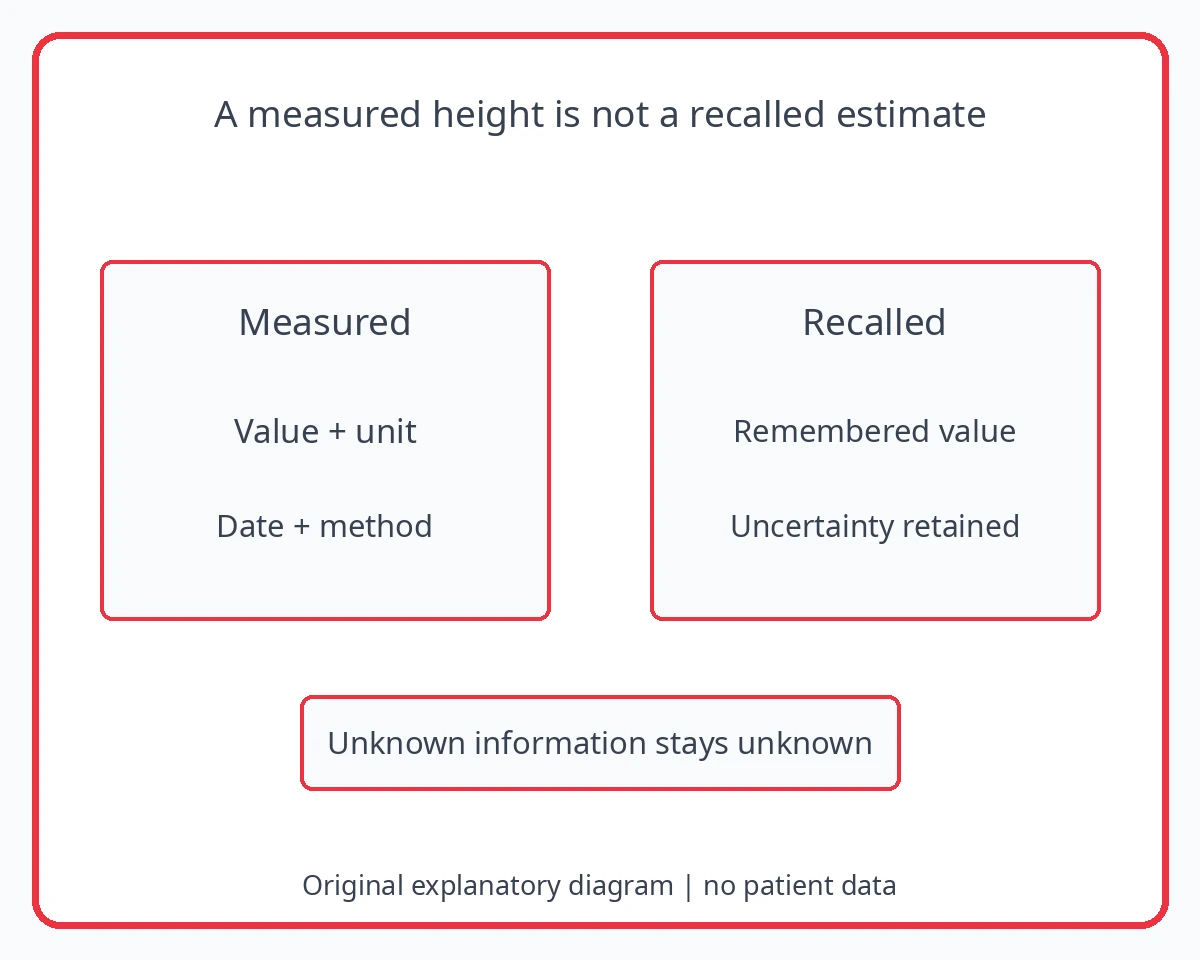
Attach a source to each available value
The NHS short-height information includes parental height in the assessment. Record the relationship, height and unit, with whether the value was measured, copied from a document or recalled. Include the measurement date if known. “Date unknown” is a valid record; an invented date makes it harder to judge how the information was obtained.
Do not give a remembered whole-number value a decimal place merely to match a form. If one parent’s height is unavailable, leave it unavailable and tell the team. A grandparent’s or sibling’s height may be separate family information, but it should not be substituted into a parent’s field without explanation. The identity of the source matters as much as a tidy table. [1]
Separate family descriptions from documented health information
A family member may remember being a “late developer” without a recorded diagnosis or precise dates. Preserve that as their description. It can lead to a useful question, but it does not establish a hereditary condition or prove that the child’s pattern has the same explanation. Avoid converting a family story into a medical label while copying it into the record.
Include only information that the person knows, is comfortable sharing and considers relevant to the appointment. When a detail is sensitive or unavailable, ask the clinician how to proceed without it. Preparing the record should not create pressure to contact an estranged relative or collect an entire family’s private medical history.
Two parent-height entries with different certainty
This fictional example shows a way to organize information for discussion. It is not a clinical record or a prescribed monitoring plan.
| Record element | Available information | How to present it |
|---|---|---|
| Parent A | Recent measured value; dated record available | Retain the value, unit and measurement date |
| Parent B | Remembers a whole-number value from years ago | Label as recalled; date unknown |
| Family description | Relative recalls developing later than classmates | A remembered description, not a diagnosis |
| Missing information | No original record for Parent B | Do not add precision or an invented date |
| Question for the team | How does this uncertainty affect the assessment? | Use the information with its limitations visible |
Matching the format does not make the evidence equivalent
In this fictional record, Parent A’s entry can be checked against a recent dated measurement. Parent B’s entry cannot. Putting both numbers into identical boxes with one decimal place would hide the difference. A short source note makes the record more useful without pretending to repair the uncertainty.
If a suitable measurement becomes available later, add it as a new sourced entry. Do not rewrite the older recollection as though it had always been a measured fact. The team can then decide which information is useful for the child’s assessment.
Keep family context separate from the child’s measured timeline in Building a Growth Diary for a Pediatric Appointment
Use family history alongside the child’s own records
The child’s growth history and measurements remain central to the appointment. Family information provides context; it does not replace an assessment of a new change or explain every concern. Ask how the clinician uses the available family history, rather than treating resemblance to one relative as the conclusion.
This worksheet does not calculate target height or supply a guaranteed adult-height range. Keep the conversation focused on health, the questions the child has and the next agreed step. A family record can be complete enough for discussion while still containing unknowns, and those unknowns do not justify inventing values. [1] For another limit on height predictions, read why an early growth rate is different from attained adult height.
For a conversation that avoids pressure about height, see Talking With a Child About Height Concerns Without Creating Pressure
Family information provides context, not a guaranteed height
No target-height formula, genetic diagnosis or predicted adult height is supplied. Missing family information should be discussed with the team without creating pressure to obtain it.
Sources and reading context
- NHS short height in children — Growth-assessment preparation; no invented referral cutoff or adult-height prediction