Recording a Child's Height at Home: Consistency and Measurement Errors
A home height entry is more useful when someone else can understand how it was measured. The floor, the head marker and the person reading the mark all matter. This guide concerns a child who can stand for measurement; it does not describe infant length or diagnose a growth problem.
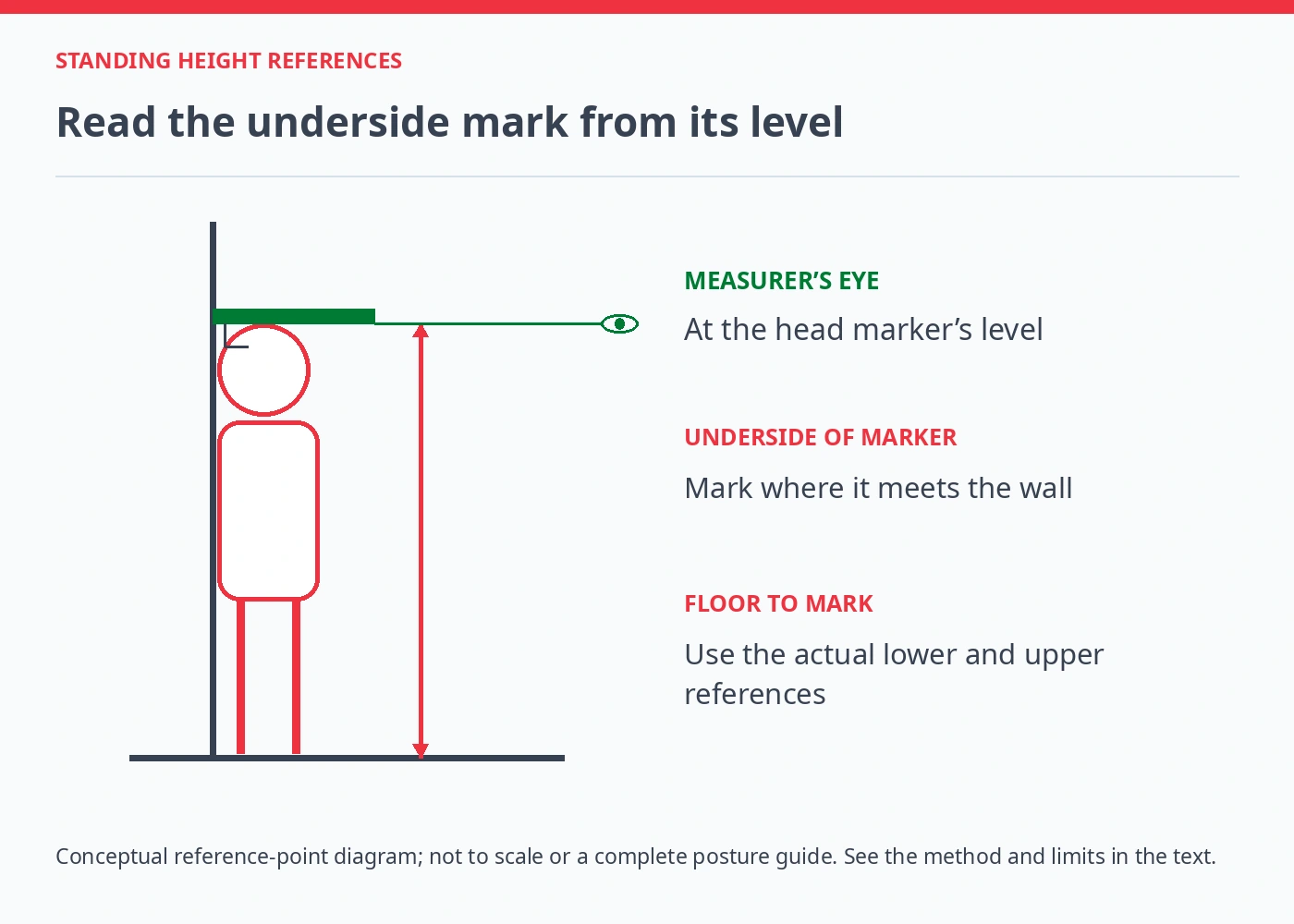
Set the lower and upper references clearly
CDC’s standing-height method uses firm flooring, no shoes and a flat vertical surface without an obstructing molding. A rigid book or ruler meets the crown at a right angle to the wall. The person measuring reads at the marker’s level and marks where its underside meets the wall; the distance runs from the floor to that mark.
The underside matters because the top of a thick book is a different point. A tilted marker can also meet the wall at a different level from where it touches the head. Identify the actual contact and reference points before reading the number. If you cannot maintain the setup comfortably and reliably, note the difficulty and ask the clinical team for an appropriate method. [1]
Keep posture and the measurement note consistent
CDC describes a child looking straight ahead with feet flat and together, legs straight and shoulders level. Its wall-contact points are the head, shoulders, buttocks and heels, but body shape affects whether all can touch the wall. Do not force an uncomfortable position to make every point contact. Remove footwear or hair arrangements that interfere rather than estimating a correction afterwards.
Write the value, unit and date alongside the method and observer. Distinguish an actual reading from an estimate recalled later. If a different device or person takes the next measurement, that is useful context, especially when the result is unexpected. A precise-looking decimal does not compensate for an uncertain mark or a method nobody can reconstruct. [1]
Two readings made with different head-marker setups
This fictional example explains how to keep a measurement record understandable. It is not a child’s clinical record or a recommended monitoring schedule.
| Part of the record | What is known | Why the distinction matters |
|---|---|---|
| Entry A | Book tilted; value written down at home | The setup has a known limitation |
| Entry B | Rigid marker held square to the wall | Method differs from A |
| Reading point | B uses the underside mark at the wall | Do not compare with the top of a book |
| Documentation | Dates, units and observer retained for both | Each reading remains traceable |
| Interpretation | No growth conclusion made from this pair | A method change may contribute to the difference |
Do not turn a better setup into an invented growth change
In the fictional pair, the marker is tilted in entry A and square to the wall in entry B. A difference between the readings cannot be treated as growth or shrinkage without considering that change in method. Nor can the earlier reading be repaired by guessing how much the tilt added.
Keep A with its limitation and B with its own date and method. If the clinical team asks for another measurement, follow its instructions and record the new observation separately. The aim is a useful history, not a sequence edited until it forms a smooth line.
Check the common sources of measurement error in Common Height-Measurement Errors That Can Confuse a Growth Record
Bring the record as one part of the assessment
The NHS information on short height describes assessment using the child’s history and growth records. A home entry can contribute information, but it does not replace a clinical measurement or interpretation. Bring the original record and explain any uncertainty instead of presenting the number alone as if every measurement were equally reliable.
If home and clinic readings differ, preserve both sources and ask how the team interprets them. Do not choose the number you prefer or begin frequent repeated checks to seek reassurance. For infants, children unable to stand reliably or any difficult measurement, ask the clinical team which method is appropriate and what information it wants collected. [2]
For the distinction between measured centimetres and a research score, see Height Standard Deviation Scores in Research: A Reader's Guide
The record supports a discussion, not a diagnosis
No measurement frequency, percentile diagnosis or treatment threshold is prescribed. For infants, children unable to stand reliably or measurements that are difficult to obtain, ask the clinical team for an appropriate method.
Sources and reading context
- CDC measuring child height and weight — Measurement consistency; not diagnosis or required monitoring frequency
- NHS short height in children — Growth-assessment preparation; no invented referral cutoff or adult-height prediction