Common Height-Measurement Errors That Can Confuse a Growth Record
When a height entry looks unexpected, check the measurement process before interpreting the difference. Shoes, an unsuitable surface or a tilted marker can make two readings difficult to compare. An error audit records those limitations; it does not calculate a corrected height from guesses.
Check what changed at the floor and wall
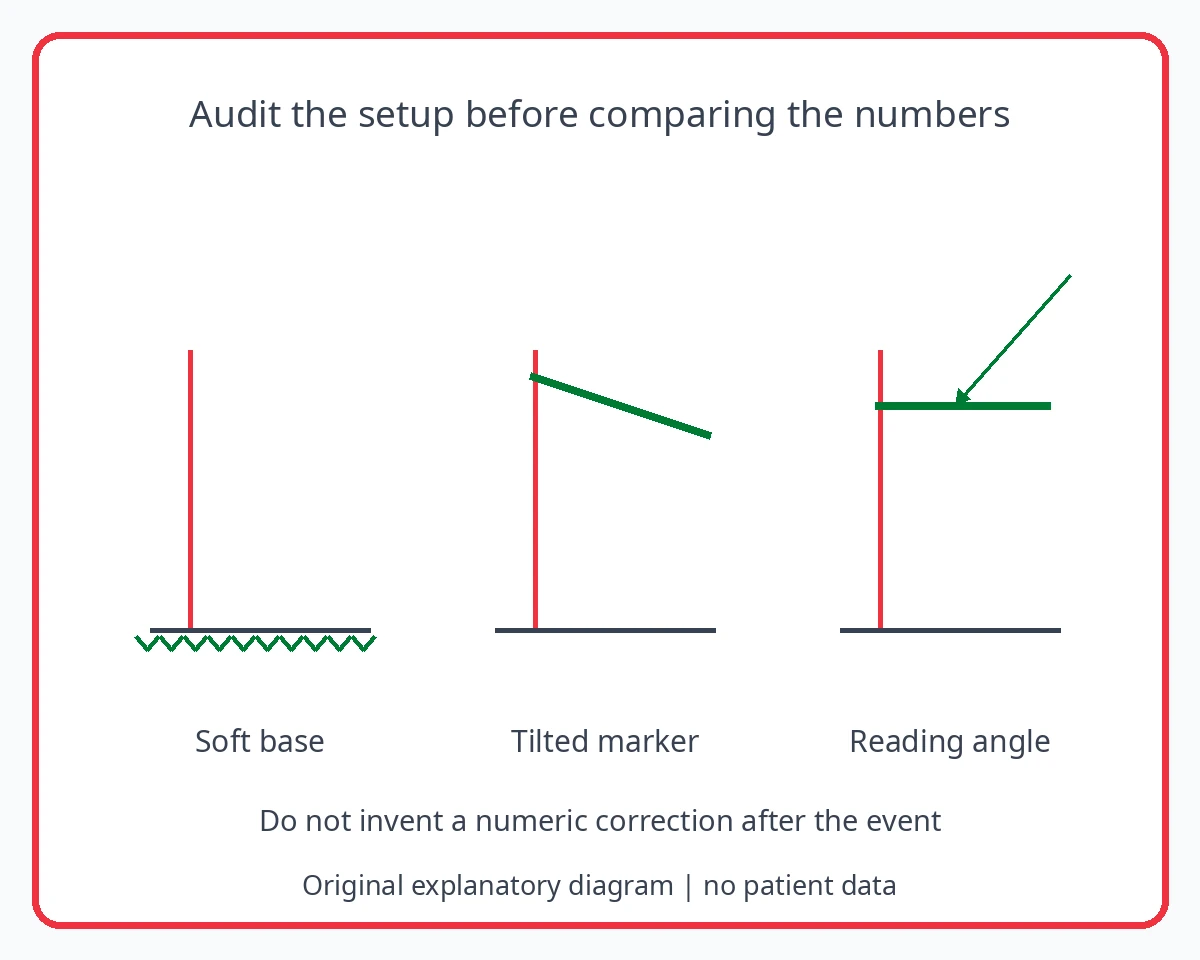
CDC’s method relies on firm flooring, bare feet and a suitable flat vertical surface. If an entry was taken on carpet or with footwear, keep that fact with the value. An obstruction at the wall can also change the intended position. A quick note about the setup may explain why a number deserves caution without telling you the exact size of any error.
Do not subtract a presumed sole thickness from a reading made in shoes. The original measurement contains more than the shoe label, and you may not know the position or reading method used. Keep “measured with shoes” as an explicit limitation. A later measurement under a different setup is a new observation, not a retroactive repair of the earlier one. [1]
Use the complete standing-height setup in Recording a Child's Height at Home: Consistency and Measurement Errors
Check how the upper mark was made and read
A rigid marker needs to be square to the wall, and CDC places the measurer’s eyes at its level. Reading from above or below changes the viewing direction. Record any known tilt or difficulty rather than choosing a correction factor from a diagram. The sketches here show possible problems, not the number of centimetres each would add or subtract.
Review the original unit and written value too. A copied number without its unit or date may be a recording problem rather than a new measurement. Ask the source of the entry what is known about the method, and retain the response. When details cannot be recovered, “method unknown” is more useful than a confident reconstruction that was never observed. [1] If a record also contains an SDS rather than centimetres, see how height reference scores differ from raw measurements.
Why “128 cm with shoes” should not become a corrected result
This fictional example explains how to keep a measurement record understandable. It is not a child’s clinical record or a recommended monitoring schedule.
| Part of the record | What is known | Why the distinction matters |
|---|---|---|
| Original entry | 128 cm, recorded on 2 October | A real recorded value, with its date |
| Known limitation | Shoes were worn | Unsuitable for direct comparison with a barefoot reading |
| Missing detail | Sole thickness and full setup not recorded | The size of the effect cannot be reconstructed |
| Tempting edit | Subtract an assumed amount | Would create an estimate presented as a measurement |
| Better record | Retain 128 cm and the footwear note | Ask how to obtain a suitable comparison if needed |
Keep the imperfect entry without giving it false precision
The fictional 128 cm entry has a clear limitation, but that does not justify replacing it with 127 cm or another guessed number. A correction would need information the record does not contain. Adding decimal places would make the estimate look more precise without making it better supported.
If a clinician later takes a reliable measurement, keep it as a separate dated entry. The comparison can then be discussed with both methods visible. There is no need to delete the earlier observation or keep measuring until two values agree.
For how growth patterns fit into a pediatric assessment, read HGHThai’s explanation of childhood growth concerns
Turn the audit into a short explanation of the uncertainty
Group the known problems into setup, marker, reading and documentation. State what was observed and what remains unknown for the particular entry. This makes it easier for the clinical team to decide which measurements can answer a useful question and whether another measurement is needed. The audit itself does not diagnose the reason for a growth pattern.
Avoid giving a child repeated measurements merely to make the spreadsheet look consistent. Keep the practical limits of home measurement visible and ask the team how it wants further information collected. A transparent imperfect record is more useful for discussion than a polished history containing invented corrections.
Keep uncertain entries identifiable when combining records with Combining School and Clinic Height Records Without Losing Context
An audit cannot recover an unknown error
This audit cannot quantify the size of an error after the event. It does not justify frequent repeated checking or a conclusion about growth from a corrected estimate.
Sources and reading context
- CDC measuring child height and weight — Measurement consistency; not diagnosis or required monitoring frequency