Why the Interval Between Height Measurements Matters
A 2 cm difference does not describe a growth rate until the time between the measurements is known. Six months and twelve months are different denominators. The calculation also depends on whether the two measurements are comparable, so an exact-looking answer can still rest on uncertain observations.
Read the height change together with the elapsed time
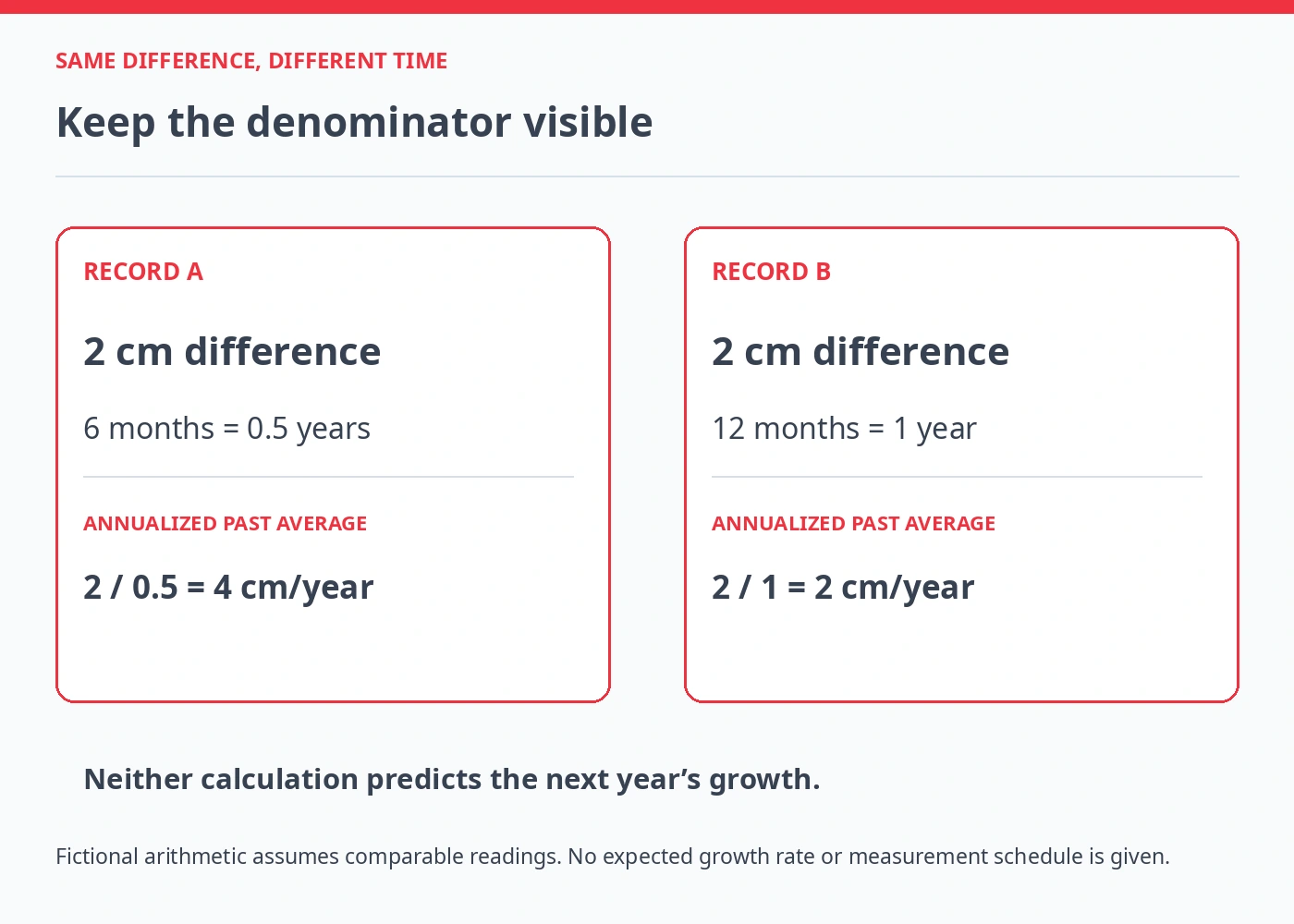
For a simple arithmetic comparison, subtract the earlier height from the later height and retain the interval between their actual measurement dates. Two fictional records can each show a 2 cm difference while covering different periods. Saying only “grew 2 cm” omits information needed to understand the average rate over that period.
In the simplified six-month example, 2 divided by 0.5 years is 4 cm per year; over twelve months, 2 divided by 1 year is 2 cm per year. These are annualized expressions of two fictional past intervals. They are not expected rates for a particular age, a recommendation about when to measure or predictions of how much a child will grow next year.
Check the observations before trusting the arithmetic
CDC describes a consistent standing-height technique. Changes in footwear, marker position or measurement method can affect comparability. When the observed difference is small, even modest measurement variation can form a substantial part of that difference. Dividing by a short interval can make an uncertain difference appear to be a large annual rate.
Keep the original dates and values alongside any calculation. If one value was rounded or its method is unknown, preserve that limitation. Do not add decimal places to an uncertain entry or choose a pair of dates because it produces a preferred rate. The calculation cannot determine how much of a difference reflects growth and how much reflects the measurement process. [1]
Same difference, different denominator
This fictional example shows a way to organize information for discussion. It is not a clinical record or a prescribed monitoring plan.
| Record element | Available information | How to present it |
|---|---|---|
| Fictional record A | 2 cm difference over exactly 6 months | Annualized arithmetic: 2 / 0.5 = 4 cm/year |
| Fictional record B | 2 cm difference over exactly 12 months | Annualized arithmetic: 2 / 1 = 2 cm/year |
| Shared limitation | Comparable measurements are assumed for this calculation | Real records need a method check |
| What the result describes | Average change over the stated past interval | Not the rate at every moment |
| What it cannot supply | Age-specific interpretation or adult-height prediction | Those questions need other information |
Annualizing a past interval is different from forecasting
Record A’s 4 cm/year expression does not establish that another 4 cm will be gained over the following year. It describes what the average would be when the observed six-month difference is expressed in yearly units. Record B has the same height difference over twice the time and therefore half the annualized rate.
The arithmetic is deliberately simple so the denominator remains visible. For a real record, use the actual dates and ask which observations the team considers suitable to compare. A copied letter date or an uncertain home reading should not silently become an exact input.
Before calculating a difference, audit measurement conditions with Common Height-Measurement Errors That Can Confuse a Growth Record
Ask which comparison answers the clinical question
The NHS growth-assessment information places measurements within the child’s wider history. Ask the team whether the available entries are sufficiently comparable and when a further measurement would be useful. A calculated rate is one piece of information; it does not by itself identify a hormone disorder or explain why a pattern has changed.
Keep the question specific: “Can these two readings be compared?” is easier to answer than “Is this rate good?” without dates, methods or context. If another reading is needed, use the team’s plan. More frequent measurement does not automatically provide a clearer answer, and this article gives no minimum interval or diagnostic cutoff. [2]
For why growth rate and adult height are different study outcomes, see Growth Rate and Adult Height: Different Outcomes in a Study
The numbers teach the calculation, not an expected outcome
No minimum interval, age-specific expected velocity or diagnostic cutoff is given. Use the clinical team’s plan rather than measuring more often to generate a larger spreadsheet.
Sources and reading context
- CDC measuring child height and weight — Measurement consistency; not diagnosis or required monitoring frequency
- NHS short height in children — Growth-assessment preparation; no invented referral cutoff or adult-height prediction